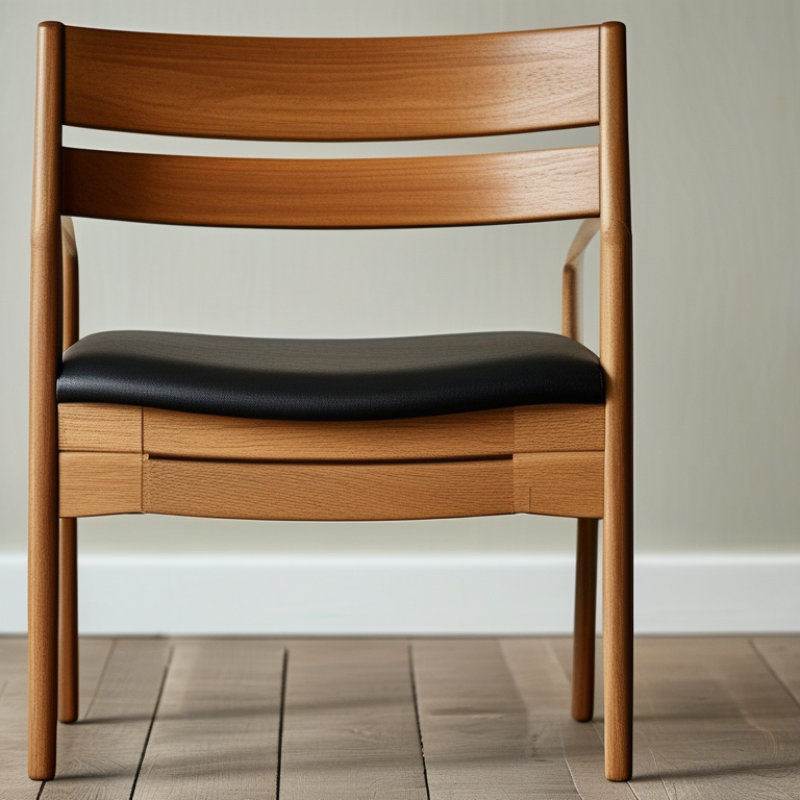
Choosing a Solid Wood Slat Back Dining Chair requires more than admiring its warm grain. A dependable chair should feel stable before it looks beautiful. Press the seat gently. Does it shift, creak, or remain firm? Examine the back slats closely. They should sit evenly, without sharp edges, loose joints, or visible gaps. Small details often reveal large manufacturing problems.
Danish furniture designer Hans J. Wegner once said, “A chair is to have no backside. It should be beautiful from all sides and angles.” That idea remains useful when judging a dining chair. View the frame from behind, below, and beside the table. Look for consistent wood color, clean mortise-and-tenon joints, and carefully sanded corners. A quality finish should protect the timber without hiding its natural texture.
Comfort also deserves practical attention. Sit for several minutes. Your feet should rest flat, while the slat back supports your lower and middle back without pressure points. Check the seat height against your dining table. Around 17 to 19 inches often suits standard tables, but body proportions vary.
Wood species matters. Oak, ash, and rubberwood can all perform well when properly dried and joined. Marketing language alone proves little. Ask about kiln drying, weight capacity, repair options, and responsible sourcing. Certification is helpful, though it is not a complete quality guarantee.
No chair is perfect. A minor color variation may be natural, not defective. Still, uneven joints should not be excused as character. The best Solid Wood Slat Back Dining Chair balances structure, comfort, honest materials, and long-term service. Take your time. Your first impression may be wrong.
How to Choose a Solid Wood Slat Back Dining Chair?
Define Your Dining Space and Chair Requirements
Begin with the room, not the chair’s finish. Measure the table, wall gaps, walkways, and door swings. The National Kitchen & Bath Association recommends about 36 inches of clearance behind occupied seating. That space allows a person to pull out a chair without blocking movement.
Measure your table height too. Most dining tables stand near 28 to 30 inches high. A chair seat around 17 to 19 inches usually creates a comfortable relationship. Allow roughly 24 inches of table width per diner. Cramped elbows quickly make attractive furniture feel impractical. My first dining layout failed because I measured the empty room, not the pulled-out chairs.
Daily use matters. The U.S. Bureau of Labor Statistics’ 2023 American Time Use Survey records about 67 minutes spent eating and drinking each day. A supportive slat back therefore needs more than visual appeal. Check the back angle, seat depth, edge comfort, and stability. Sit for several minutes if possible. Short tests can mislead.
Solid wood adds durability, but it also brings weight and seasonal movement. Look for tight joints, evenly spaced slats, smooth edges, and a finish that feels pleasant against the hand. Households with children may need wider feet and easy-clean surfaces. Smaller rooms may benefit from armless chairs that slide fully beneath the table. Requirements change. Your room may expose that quickly.
How to Choose a Solid Wood Slat Back Dining Chair?
Wood species shapes a chair’s appearance, strength, and aging pattern. Oak usually has visible pores and a pronounced grain, while beech offers a smoother, more even surface. Ash can feel light but remains structurally reliable when properly dried. I have found that species names alone prove little. Drying quality and careful selection matter just as much.
Study the grain across the seat, rails, and slats. Straight, consistent grain often supports better stability, while abrupt changes may signal natural weakness. Small knots are not always defects, but loose knots deserve caution. Check whether the slats align evenly and feel smooth beneath your fingertips. Then inspect the joints. Tight mortise-and-tenon joints, reinforced dowels, or precise corner blocks usually indicate thoughtful construction. Wobbling is a warning. So is a chair that creaks under light pressure.
Tips: Sit naturally and shift your weight slightly. Listen for movement. Examine the underside, not just the polished surfaces. Ask about moisture control and finish maintenance. A glossy coating can hide uneven sanding. I once trusted a beautiful grain pattern and missed a poorly fitted rear joint. That mistake changed how I inspect chairs. No chair is flawless. Look for balanced workmanship, not decorative perfection.
| Evaluation Area | Wood Species or Feature | Useful Data | What to Inspect | Dining-Chair Implication |
|---|---|---|---|---|
| Wood Species and Performance Data | ||||
| Hardness | Hard maple | Janka hardness: approximately 1,450 lbf Density: approximately 705 kg/m³ at 12% moisture content |
Look for straight, continuous grain and cleanly machined edges. Check that the slats have no deep dents, loose knots, or crushed end grain. | Very good resistance to everyday dents and abrasion. Its relatively light color makes surface marks easier to see. |
| Hardness and wear resistance | White oak | Janka hardness: approximately 1,360 lbf Density: approximately 700 kg/m³ at 12% moisture content |
Examine the prominent grain for splits, checks, and open defects. Quarter-sawn or rift-sawn components may show straighter grain and stronger visual stability. | A durable choice for frequent dining use. The open grain gives a distinctive appearance but requires thorough finishing to reduce dirt collection. |
| Hardness and resilience | Ash | Janka hardness: approximately 1,320 lbf Density: approximately 670 kg/m³ at 12% moisture content |
Inspect the long earlywood pores and grain transitions for cracks. Slats should be free from large knots, especially near screw holes or joints. | Strong, springy, and suitable for chair frames and slats. Its pronounced grain can provide a lighter, more casual appearance. |
| Hardness and dimensional behavior | Beech | Janka hardness: approximately 1,300 lbf Density: approximately 710 kg/m³ at 12% moisture content |
Check for end splits and evidence of moisture-related movement. Curved parts should have smooth bends without compression wrinkles or visible cracks. | Uniform texture and good bending performance make it suitable for shaped chair components. Stable indoor humidity is still important. |
| Hardness and appearance | Black walnut | Janka hardness: approximately 1,010 lbf Density: approximately 610 kg/m³ at 12% moisture content |
Look for consistent color matching, tight knots, and clean joinery. Darker wood can conceal small surface defects, so inspect edges and underside areas carefully. | Provides an elegant appearance and adequate dining-chair durability, but it is more vulnerable to dents than harder maple or oak. |
| Hardness and color | Black cherry | Janka hardness: approximately 950 lbf Density: approximately 580 kg/m³ at 12% moisture content |
Check for dents, compression marks, and uneven color. Natural color darkening should not be confused with water staining or finish failure. | Works well for residential dining use when properly finished, but its softer surface needs more care against sharp impacts. |
| Grain, Moisture, and Dimensional Stability | ||||
| Grain direction | Straight, continuous grain | Preferred condition: grain generally follows the length of the slat, leg, or rail | Avoid severe runout, abrupt grain changes, and cross-grain defects at narrow slats or joints. | Improves strength along the component and reduces the risk of splitting under repeated loading. |
| Knots and natural defects | Tight knots only | Preferred condition: no loose knots, large voids, bark pockets, or open checks in structural parts | Pay special attention to legs, front rails, seat supports, and the ends of back slats. | Small tight knots may be acceptable for appearance, but structural areas should be as clear and continuous as practical. |
| Moisture content | Indoor-dried solid wood | Typical target: approximately 6%–8% moisture content for many conditioned interiors | Ask whether the wood was acclimated before machining and finishing. A moisture meter can help identify unusually wet or dry components. | Wood that is too wet or too dry can shrink, swell, open joints, or develop cracks after the chair enters a different indoor environment. |
| Wood movement | Seasonal expansion and contraction | Approximate tangential shrinkage from green to oven-dry: about 7%–12% for many common hardwoods Approximate radial shrinkage: about 3%–6% |
Look for designs that allow movement across the grain, especially around solid-wood seats, panels, and wide rails. | Solid wood is not dimensionally inert. Good design and suitable indoor humidity are essential for long-term joint integrity. |
| Surface preparation | Uniformly sanded and finished | Inspection standard: no sharp edges, raised grain, sanding swirls, finish runs, or bare patches | Run a hand over the top, underside, slats, and front edges. View the chair under angled light to reveal uneven finish or scratches. | A consistent finish protects the wood from spills and reduces moisture absorption during normal dining use. |
| Construction Quality and Slat-Back Design | ||||
| Leg-to-rail joints | Mortise-and-tenon or reinforced corner construction | Preferred condition: tight, flush joints with no visible gaps or excessive filler | Press and gently rack the chair from side to side. Listen for clicking or creaking and observe whether joints move independently. | Strong primary joints resist loosening better than relying only on surface screws, nails, or adhesive in end grain. |
| Back-slat attachment | Captured or securely fastened slats | Preferred condition: slats remain aligned, evenly spaced, and free from lateral movement | Apply light hand pressure to each slat. Check for rattling, sharp corners, unequal spacing, and cracks near fasteners. | Secure slats provide consistent back support and prevent noise or progressive loosening during repeated use. |
| Slat dimensions | Adequate thickness and rounded edges | Practical benchmark: slats should feel rigid under moderate hand pressure; commonly used slats are often about 12–20 mm thick, depending on width, span, and species | Do not judge thickness alone. Consider the slat width, unsupported span, grain direction, attachment method, and species hardness together. | A thin or overly wide slat with a long unsupported span may flex more, even when made from a strong species. |
| Seat support | Supported seat frame | Preferred condition: seat rails are firmly joined and the seat does not shift when loaded | Sit centrally and near the front edge. Check for movement, squeaks, sagging, or gaps between the seat and frame. | A rigid seat frame distributes body weight and reduces stress on the back, legs, and corner joints. |
| Chair stability | Level four-leg base | Preferred condition: all four legs contact the floor without rocking on a flat surface | Test on a hard, level floor. Inspect leg ends for uneven cuts, cracks, or poorly fitted glides. | A level base improves comfort and reduces uneven loading that can loosen joints over time. |
| Fasteners and repairs | Appropriate, concealed reinforcement | Preferred condition: no protruding screws, stripped heads, oversized plugs, or exposed structural cracks | Inspect the underside, rear joints, and areas around screw holes. Repairs should be clean, tight, and structurally purposeful. | Visible fasteners are not automatically a defect, but fasteners should reinforce sound joints rather than compensate for poor-fitting parts. |
| Load and safety check | Intended residential use | Reference: verify the stated weight capacity and applicable safety testing; do not infer capacity from appearance alone | Check whether the chair has been tested for repeated loading, front-edge loading, backrest loading, and stability. | Documented testing is more reliable than a visual estimate when chairs will be used frequently or by heavier occupants. |
| Quick Selection Summary | ||||
| Best all-around durability | Hard maple, white oak, ash, or beech | Typical hardness range: approximately 1,300–1,450 lbf | Prioritize clear grain, dry and acclimated wood, tight joints, rigid slats, and a level base. | These species generally offer a strong balance of wear resistance and structural performance for dining chairs. |
| Best appearance-led choice | Black walnut or black cherry | Typical hardness range: approximately 950–1,010 lbf | Inspect more carefully for dents, finish damage, and color variation while maintaining the same construction standards. | Suitable for dining use when protected with a durable finish and handled carefully. |
| Final buying priority | Construction before color | Recommended order: joint integrity → wood condition → slat design → finish appearance | Choose a chair that remains rigid, level, quiet, and comfortable during hands-on testing. | A well-constructed chair made from a moderately hard species can outperform a poorly joined chair made from a harder species. |
A solid wood slat back dining chair should support your back without feeling stiff. The slats need even spacing and a gentle curve that follows your posture. When seated, your shoulders should rest naturally, not push forward. Run your hand across each slat. Smooth, rounded edges show careful finishing and reduce pressure during long meals.
Sit for several minutes before choosing. Short tests can hide discomfort. Check whether the back supports your lower and middle back. A chair that feels firm at first may become tiring after an hour. I once preferred a dramatic, widely spaced design, but it offered little support during extended dinners. That mistake changed how I assess dining chairs.
The gap between slats also affects comfort and stability. Narrow gaps can provide a stronger visual frame, while wider gaps may improve airflow. However, overly wide spacing can leave unsupported areas behind your back. Press gently against the backrest and listen for movement or creaking. Solid wood naturally changes with humidity, so small seasonal shifts are possible. Loose joints are different and deserve caution. Look for secure connections, consistent alignment, and a backrest that does not flex excessively. A seat cushion may improve comfort, but it cannot correct poor slat placement.
Choosing a solid wood slat-back dining chair starts with the seat, not the finish. ANSI/BIFMA G1-2013 uses the 5th-to-95th percentile adult range for ergonomic fit. That supports adjustable thinking, even for fixed dining chairs. Aim for a seat height near 17–19 inches. Leave about 10–12 inches between the seat and tabletop. A seat width of 16–19 inches usually supports varied body sizes. Measure your table before ordering.
Material changes comfort. Solid wood feels firm, stable, and easy to clean, but it can create pressure under the thighs. Upholstered seats soften contact and reduce noise. However, fabric may hold crumbs and moisture. Molded wood or plywood can flex slightly, though quality varies. Look for a rounded front edge, smooth sanding, and slats that support the back without sharp contact points. Cornell University’s ergonomics guidance recommends keeping both feet supported and avoiding pressure behind the knees. My own testing sometimes favors a thin cushion, yet cushions can raise the body too much.
Tips: Sit for ten minutes before buying. Check whether your feet rest flat. Try leaning back naturally. Keep a small gap behind your knees. A chair may look elegant but still feel tiring. Recheck the dimensions with shoes, table aprons, and nearby chairs. ANSI/BIFMA G1-2013 and Cornell’s Human Factors research offer useful reference points, but personal fit remains imperfect and deserves honest testing.
Compare seat materials, dimensions, and ergonomic design targets for everyday dining comfort.
The chart uses common residential dining-chair design ranges: seat height 43–48 cm, seat depth 40–45 cm, seat width 45–52 cm, and backrest height 35–45 cm. For most users, a seat height near 45 cm and a seat depth around 42 cm provide a balanced starting point.
A solid wood slat back dining chair earns its value through finish quality, maintenance demands, and service life. Inspect the surface under natural light. A consistent sheen, smooth edges, and sealed end grain suggest careful workmanship. Small variations in color are normal because timber is not printed plastic. However, rough slats or sticky coatings deserve caution.
Finish affects daily upkeep. The USDA Forest Products Laboratory’s Wood Handbook explains that wood continually exchanges moisture with surrounding air. Seasonal movement is expected, especially near heating vents or sunny windows. Keep indoor humidity reasonably stable, and wipe spills quickly with a soft, damp cloth. Avoid soaking the slats. Harsh cleaners may dull the coating or leave cloudy patches. I once underestimated how quickly crumbs collect between narrow slats; a soft brush makes cleaning easier than repeated scrubbing.
Value depends on more than the purchase price. The 2023 Global Furniture Market Report from CSIL identifies replacement demand and product durability as important market factors. A chair with replaceable floor glides, accessible screws, and a repairable finish may cost more initially, yet reduce future waste. Check whether the joints feel tight when you gently shift the chair. A beautiful finish cannot rescue loose joinery. Be realistic, too: “maintenance-free” is usually an advertising phrase, not a long-term promise.