How to Choose White Acrylic Dining Table and Chairs?
Choosing White Acrylic Dining Table And Chairs is not just a color decision. The set must suit your room, daily routine, and tolerance for visible marks. White can brighten a dim corner, while acrylic’s smooth surface gives a compact dining area a lighter look. But glossy finishes may show fingerprints, fine scratches, and crumbs more clearly than textured surfaces. Looks matter.
Market context helps, but it cannot tell you which table fits your home. Grand View Research estimated the global furniture market at USD 677.09 billion in 2023 and projected a 5.5% compound annual growth rate from 2024 to 2030. That figure covers furniture broadly, not acrylic dining sets. It signals a large, evolving market, not proof that one material is right for everyone.
Before choosing, measure the tabletop, chair pull-out space, and walking paths. A chair that fits beneath the table in a showroom may feel cramped beside a wall at home. Check whether the material is solid acrylic or an acrylic finish over another substrate, and ask the seller about cleaning and care. Product descriptions can be vague; that is worth questioning. For everyday use, compare seat height, back support, edge comfort, and the stability of the base. Bring your room measurements, inspect the finish in natural light, and consider how often you are willing to wipe it down. A beautiful set still needs to work on an ordinary Tuesday.
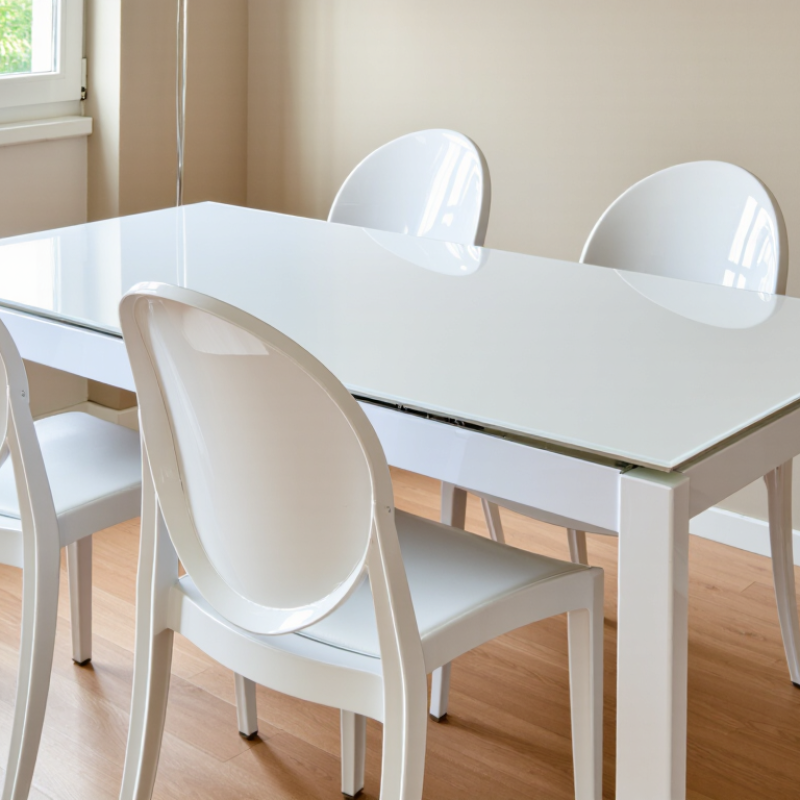
Measure the Room: ADA Accessible Routes Require 36 in (915 mm) Minimum Width
Before choosing a white acrylic dining table and chairs, measure the room’s walking paths, not just the table footprint. An accessible route generally needs at least 36 inches (915 mm) of clear width under ADA standards. Keep that space open between furniture, walls, and doorways. Measure the narrowest point, including chair backs when chairs are pulled out. A tape measure on the floor helps reveal tight spots that a quick visual estimate can miss.
Quick check: Measure the narrowest point with the chairs pulled out, not just the open floor around the table.
Try it in real life. Pull each chair out as someone would during a meal, then check whether the route remains clear. Acrylic furniture can look visually light, but its legs and chair edges still occupy floor space. Leave room for a person to pass without turning sideways or bumping a chair. If the room has a doorway or a change in direction, test that area too. Small shifts matter. A slimmer table may work better than squeezing in extra seats, though I’ve found that layouts can feel different once people are actually seated. Clear widths can depend on the route’s conditions, so verify applicable accessibility guidance for the specific space.
Choose Table Height: Standard Dining Tables Measure 28–30 in (71–76 cm)
A standard dining table stands 28–30 inches (71–76 cm) high, a range that suits many adults and everyday meals. With a white acrylic table, height matters as much as its clean, bright appearance. Sit at the table before buying, if possible. Your elbows should rest comfortably near the tabletop without lifting your shoulders. Small differences can feel surprisingly noticeable during a long dinner.
Check the chair seat height, too. Many dining chairs measure about 17–19 inches (43–48 cm) from floor to seat, leaving roughly 10–12 inches (25–30 cm) between the seat and tabletop. This space helps your legs move freely. Measure from the floor to the underside of the table, not just to its top; a thick edge or support rail can reduce knee room. Acrylic surfaces can make a room feel open, but they do not make an awkward fit more comfortable.
If you are pairing separate pieces, compare their actual measurements rather than relying on a product photo. Place a chair beside a similar-height table at home and test the fit. I have found that paper measurements can miss small comfort issues. That is worth checking twice. For homes with children or varied-height users, adjustable chairs may help, though they can alter the table’s neat, coordinated look.
How to Choose a White Acrylic Dining Table and Chairs?
Standard dining tables are typically 28–30 inches (71–76 cm) high. Compare common table heights below before selecting chairs.
For a comfortable dining setup, choose chairs with a seat height of approximately 17–19 inches (43–48 cm), leaving enough legroom beneath the tabletop.
Match Chair Seats: Typical Dining Seat Height Is 17–19 in (43–48 cm)
Choosing a white acrylic dining table and chairs starts with proportion, not appearance alone. A bright white surface can make a room feel larger, but uncomfortable seating will quickly spoil that effect. Measure from the floor to the top of the chair seat. Typical dining seat height is 17–19 inches (43–48 cm).
Leave about 10–12 inches (25–30 cm) between the seat and the underside of the tabletop. This space gives your knees room and supports a relaxed dining posture. Check the table apron, too. A thick apron can reduce leg clearance, even when the overall table height seems suitable. For most dining tables, a tabletop around 28–30 inches high works well with standard chairs.
I once chose chairs by color first and regretted it after a long dinner. The seats looked elegant, but their height felt slightly low. Sit in the chair for several minutes before buying. Your feet should rest flat, and your elbows should reach the tabletop without lifting your shoulders. Acrylic seats can feel firm, especially without cushions, so test the edge against the backs of your legs. Not every “standard” chair fits every body. Measurements help, but comfort still needs a real trial.
How to Choose White Acrylic Dining Table and Chairs? — Match Chair Seats: Typical Dining Seat Height Is 17–19 in (43–48 cm)
| Chair Seat Height |
Suggested Tabletop Height |
Approx. Seat-to-Tabletop Difference |
Fit Guidance |
What to Check |
| 17 in (43.2 cm) |
28–29 in (71–74 cm) |
11–12 in (28–30 cm) |
A good pairing for a lower dining table; allows comfortable space between the seat and tabletop. |
Confirm that the chair can slide under the table and that the table apron does not restrict the knees. |
| 18 in (45.7 cm) |
28–30 in (71–76 cm) |
10–12 in (25–30 cm) |
A versatile choice for many standard-height dining tables. |
Measure from the floor to the top of the seat, including any cushion. |
| 19 in (48.3 cm) |
29–30 in (74–76 cm) |
10–11 in (25–28 cm) |
Works best with a table toward the higher end of the standard dining-height range. |
Check the table’s underside height, especially if the chairs have arms. |
| 17–19 in (43–48 cm) |
28–30 in (71–76 cm) |
Usually about 10–12 in (25–30 cm) |
Compare the actual chair and table measurements before buying; dimensions can vary by design. |
For a white acrylic set, also check that chair legs and table supports fit comfortably around one another. |
Measurement tip: Seat height is measured from the floor to the top of the chair seat. Measure table height from the floor to the tabletop, and check the clearance beneath the table separately. A difference of roughly 10–12 in (25–30 cm) is a useful starting point, but personal comfort and chair design matter.
Check Acrylic Quality: PMMA Has a Typical Density of About 1.18 g/cm³
How to Choose White Acrylic Dining Table and Chairs?
When choosing white acrylic furniture, check the material before admiring its glossy finish. Solid PMMA, commonly called acrylic, has a typical density of about 1.18 g/cm³. Engineering material references usually place clear PMMA between 1.17 and 1.20 g/cm³. ISO 1183-1:2019 and ASTM D792 describe standard density-testing methods for plastics. These standards support a simple comparison: measure a sample’s mass and volume, then calculate density as mass divided by volume.
A low result may indicate foaming, excessive fillers, or a hollow structure. It does not automatically prove poor quality. Furniture parts can include coatings, adhesives, or metal supports. White surfaces also hide internal defects better than transparent sheets. Inspect the table edge under strong light. Look for cloudy streaks, uneven color, bubbles, and brittle-looking corners. Tap gently. A consistent sound is useful, but this test is imperfect.
Tips: Ask for the PMMA grade, sheet thickness, and a technical data sheet. Compare the stated density with approximately 1.18 g/cm³. Weighing a loose sample can help, but it cannot replace laboratory testing. For dining chairs, check reinforced joints and load-bearing areas separately. Density alone cannot confirm UV stability, impact resistance, or long-term safety. A supplier who provides test methods and tolerances shows stronger technical reliability.